National Dish Argentina: Milhojas de Dulce de Leche (Recipe)
In this article
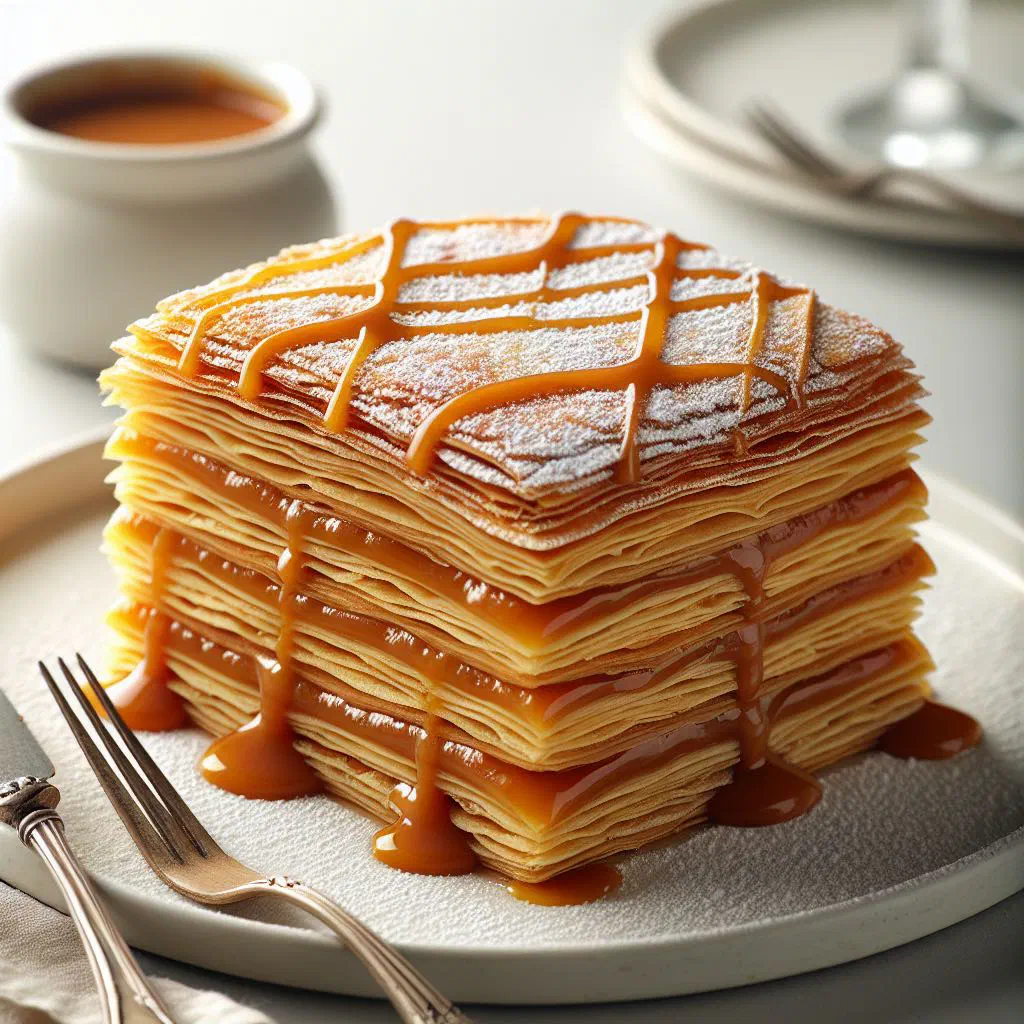
Discover Milhojas de Dulce de Leche, one of Argentina’s most beloved sweets. Wafer-thin sheets of puff pastry are layered with rich, caramel-dark dulce de leche and finished with a snowfall of icing sugar. It is the kind of dessert that turns up whenever there is something to celebrate, a birthday, a holiday, a Sunday worth stretching out. Best of all, it brings a little of Argentina’s warmth straight into your own kitchen.
About Milhojas de Dulce de Leche
Milhojas de dulce de leche is a traditional Argentinian dessert that is cherished at home and admired far beyond the country’s borders. The pairing of delicate puff pastry and creamy dulce de leche creates a balanced sweetness that wins over anyone with a fondness for puddings. On special occasions, birthday parties, festive gatherings, holidays, it is invariably the star of the table. Making it is a rewarding piece of cookery and a way of inviting a touch of Argentinian culture into your home.
Ingredients (serves 1–2)
- 250 g puff pastry
- 400 g dulce de leche
- Icing sugar, for dusting
- Optional: chocolate, for decorating
Shopping for the ingredients
The ingredients for milhojas de dulce de leche are available in most supermarkets and delicatessens. Puff pastry is often sold ready-rolled, which makes the whole process considerably easier. Dulce de leche can be bought either in jars or in tins. If you would rather make your own, you will additionally need milk, sugar and a little vanilla, a route that rewards you with an even more authentic flavour.
Preparing the dish
Before you begin, it is worth laying out all your ingredients and equipment. The puff pastry should be brought up to room temperature so that it handles more easily. It also pays to dust your work surface with a little flour to stop anything sticking. A baking tray and a rolling pin are useful too, so you can roll the pastry out to an even thickness.
Step-by-step instructions
- Preheat the oven to 200°C.
- Roll the puff pastry out thinly on a floured surface.
- Cut the pastry into even rectangles, roughly 5 × 10 cm.
- Lay the pieces on a baking tray lined with baking parchment and bake for about 15–20 minutes, until golden brown.
- Leave the pastry pieces to cool, then spread each one generously with dulce de leche.
- Stack the pieces on top of one another and dust the dessert with icing sugar. If you like, drizzle over some melted chocolate.
Gluten-free / lactose-free version
For a gluten-free version, use one of the special gluten-free puff pastries now stocked by many shops. Check that the dulce de leche is gluten-free as well, and read through all your ingredients for hidden sources of gluten. For a lactose-free result, make the dulce de leche with lactose-free milk. That way even those who are lactose intolerant can enjoy this wonderful dessert.
Tips for vegans and vegetarians
Vegans can reach for a plant-based puff pastry containing little to no animal produce, many all-butter alternatives are made with vegetable fats. There are also recipes for dulce de leche that use almond or coconut milk in place of dairy and still deliver a superb flavour. When shopping, simply check the labels for animal-derived ingredients. With these small adjustments, vegan cooks can enjoy milhojas de dulce de leche in full.
More tips and tricks
To make the layers more interesting still, try varying the filling. A combination with freshly whipped cream or a spoonful of fruit purée makes for an exciting change. Make sure the pastry pieces are thoroughly cool before you start spreading, so the filling does not melt away. It also helps to let the assembled dessert rest for a while, giving the flavours time to settle and open up.
Adapting the recipe to your taste
This dessert takes happily to personal touches. Keep it purist with nothing but pastry and dulce de leche, or build it higher in the style of a Rogel, the towering cousin of the milhojas. A pinch of sea salt over the caramel sharpens the sweetness beautifully, while a splash of citrus zest in the cream lightens the whole thing. The number of layers is entirely up to you.
Ingredient substitutions
If you have no puff pastry to hand, other doughs work well too, filo pastry, for instance, gives a similarly crisp texture. Ready-made vegan versions of dulce de leche are widely sold, and you can even use honey or agave syrup if you simply want a sweet filling without the classic ingredients. Substitutions like these let you tailor the recipe to different tastes and diets while keeping its essential character, much as cooks do with Panqueques con Dulce de Leche.
Drink pairing ideas
A classic milhojas de dulce de leche goes superbly with a coffee or an espresso. Both cut through and complete the sweetness of the dessert, rounding out the whole experience. A robust tea, a good black tea, say, is an equally fine choice, as is a cup of Mate Cocido for something more distinctly Argentinian. For a lighter option, fruit juices refresh the palate nicely after all that caramel.
Serving and presentation ideas
To serve the dessert at its best, arrange the layers on a handsome cake stand. A dusting of icing sugar lends it an elegant finish. You might add fresh berries or mint leaves as decoration. They look lovely and contribute a welcome note of freshness. Presented like this, milhojas de dulce de leche becomes more than a treat for the palate but a centrepiece for the table.
A bit of history
The roots of the milhojas reach far back into European baking, particularly the French and Spanish traditions. Argentinians, however, perfected the recipe with their own characteristic dulce de leche. This dessert is more than a sweet indulgence: it is a piece of Argentinian culture, served at celebrations and festivals throughout the year. Making it is an art passed down through the generations, and one that younger cooks are embracing with real enthusiasm, much like the rest of Argentinian cuisine.
More recipe ideas
Summary: Milhojas de Dulce de Leche
Milhojas de dulce de leche is a delicious, deeply traditional Argentinian dessert that appeals to with its delicate pastry layers and sweet dulce de leche filling. Thanks to the many ways it can be adapted, both traditionalists and modern cooks will find their own version to enjoy. The pleasure lies in the making as much as in the eating. Let a little Argentinian joie de vivre inspire you and bring a piece of that culture to your table.