
National Dish Poland: Bagels (Recipe)
In this article
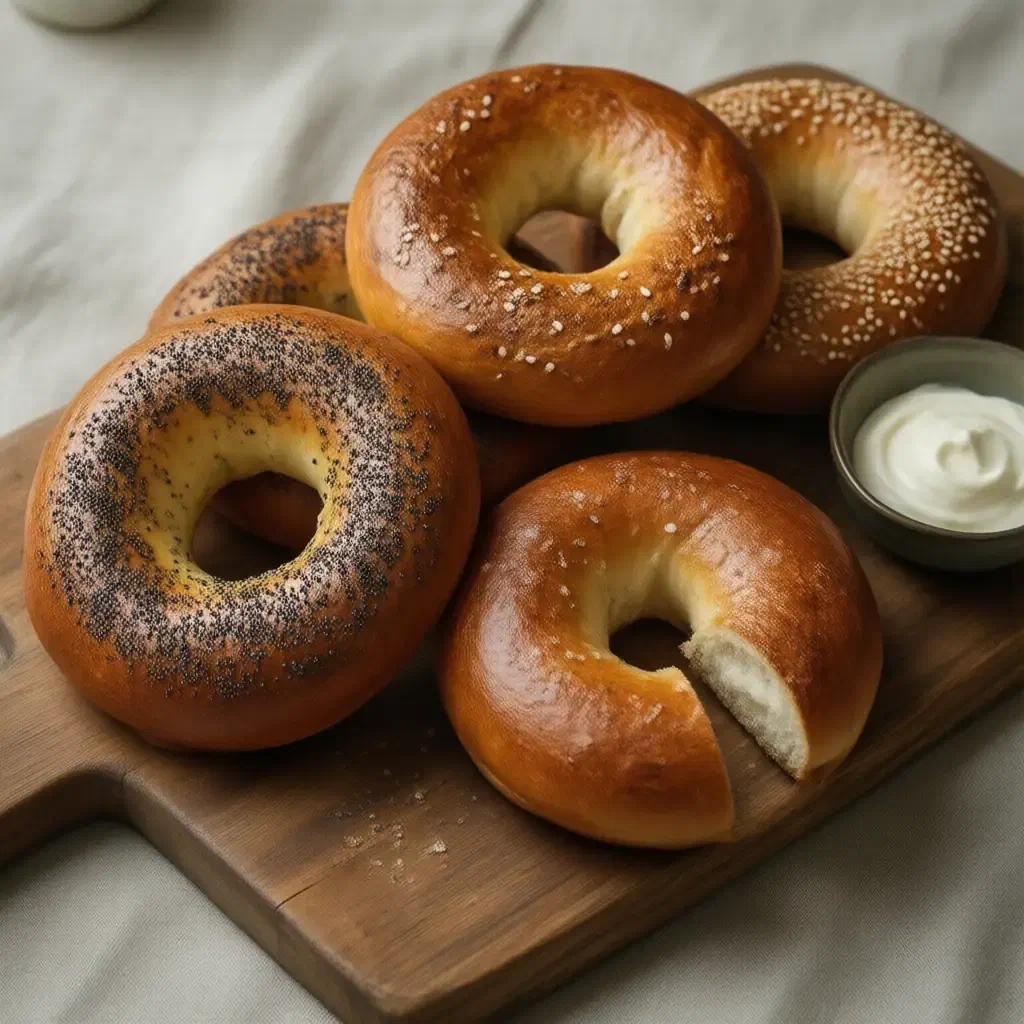
Long before bagels became famous in New York, they were being baked in Kraków. Bagels, called bajgiel in Polish, are briefly boiled before they go into the oven. That is what gives them their glossy, slightly chewy crust and their firm crumb. This recipe makes four, and the dough is best left to rest in the fridge overnight.
About Bagels
Bagels are rings of yeast dough with a hole in the middle, first boiled in water and then baked. The dough is stiff and contains little water, so the crumb is dense and springy. The crust is shiny and offers a little resistance when you bite into it. In Poland they are sprinkled with poppy seeds, sesame seeds or coarse salt, much like the obwarzanek, the twisted ring that street vendors in Kraków sell from their carts. Bagels are eaten sliced for breakfast, for instance with cream cheese or Ser biały, the Polish curd cheese. In the USA they became the classic Bagels with Lox, topped with smoked salmon.
Ingredients (serves 1–2)
- 250 g Type 550 wheat flour
- 135 ml lukewarm water
- 5 g fresh yeast
- 5 g salt
- 10 g honey or malt syrup for the dough
- 1.5 l water for boiling
- 1 tbsp honey for the boiling water
- 1 tbsp poppy seeds
- 1 tbsp sesame seeds
- 1 pinch coarse sea salt
Shopping for the ingredients
Bagels need a flour with plenty of gluten. Type 550 wheat flour is the best choice; a softer Type 405 flour makes the bagels softer and flatter. Malt syrup from a health food or organic shop gives the typical light malty note and a darker crust. Honey works just as well. Fresh yeast is in the chilled section next to the butter. For the topping, use blue poppy seeds, the same kind that goes into Makowiec, and unhulled sesame seeds, which toast more deeply in the oven.
Preparing the dish
It is best to spread the bagels over two days. Knead the dough in the evening, shape the rings and let them mature in the fridge overnight. This way they develop more flavour and can go straight into the pot the next morning. Have a baking tray lined with baking paper and a slotted spoon ready. Put the poppy seeds and sesame seeds into two shallow plates. For eight bagels, double all the ingredients; the boiling water is then enough for two batches.
Step-by-step instructions
- Dissolve 5 g yeast and 10 g honey in 135 ml lukewarm water, add 250 g flour and 5 g salt and knead everything for 10 minutes into a firm, smooth dough.
- Leave the dough to rest, covered, for 1 hour at room temperature. It will rise only a little.
- Divide the dough into 4 pieces of about 100 g each, roll each one into a 22 cm long rope and overlap the ends by 3 cm. Roll the join firmly under the flat of your hand until you have a closed ring.
- Place the rings on the baking paper, cover them with cling film and put them in the fridge for 12 to 16 hours. If you are in a hurry, let them prove for 45 minutes at room temperature instead.
- Preheat the oven to 220 °C (conventional, top and bottom heat). Bring 1.5 l water with 1 tbsp honey to a simmer.
- Lower the bagels into the simmering water two at a time and boil them for 45 seconds on each side. Lift them out with the slotted spoon and let them drain briefly.
- Press the damp tops straight into the poppy seeds or sesame seeds and sprinkle over a little coarse salt. Return the bagels to the tray, topped side up.
- Bake the bagels on the middle shelf for 18 to 22 minutes until deep golden brown. Leave them to cool on a wire rack for at least 20 minutes.
Gluten-free / lactose-free version
Bagels are lactose-free: the classic dough contains neither milk nor butter. If you use a ready-made flour mix, just check whether milk powder has been added. Going gluten-free is harder, because the chewy texture comes from the wheat gluten. Even so, a gluten-free bread mix with 5 g psyllium husk powder will still give you decent rings. Boil them for only 20 seconds on each side, or they will fall apart.
Tips for vegans and vegetarians
With malt syrup instead of honey, bagels are vegan. Many vegans do not consider honey vegan, so it is worth making the swap in both the dough and the boiling water. For a topping, try a cashew-based vegan cream cheese with cucumber and chives, or a spread made from 100 g white beans, 1 tbsp lemon juice and herbs. For vegetarians, a bagel with egg and radishes is delicious.
More tips and tricks
If the bagels turn out flat and wrinkled, they proved for too long before boiling. Do the float test. A ring that rises to the top of a bowl of water after a few seconds is ready. If it sinks, it needs another 15 minutes. Boiling for longer makes the crust thicker and chewier, boiling for less time makes it softer. Fresh bagels keep for 2 days in a paper bag. Sliced and frozen, they keep for 2 months and can go straight into the toaster.
Adapting the recipe to your taste
For a wholemeal bagel, replace 80 g of the wheat flour with wholemeal wheat flour and add 10 ml more water. Cinnamon and raisin bagels get 1 tsp cinnamon and 40 g raisins in the dough. Besides poppy and sesame seeds, good toppings include crispy fried onions, caraway seeds or a mix of everything, which in the USA is called Everything. If you prefer them sweet, leave off the salt on top.
Ingredient substitutions
Instead of fresh yeast you can use 2 g dried yeast and mix it straight into the flour. Malt syrup and honey can replace each other, and sugar beet syrup works too. Some bakers add a teaspoon of bicarbonate of soda to the boiling water; the crust then turns darker and tastes slightly like a pretzel. If you have no poppy seeds, use nigella seeds or linseeds.
Drink pairing ideas
In Poland, breakfast comes with black tea with lemon, often served in glasses. A bagel with cream cheese also goes well with a milky coffee or a glass of buttermilk. In the afternoon, try a cold kompot made from apples or strawberries, which many Polish families make in summer.
Serving and presentation ideas
Slice the bagels horizontally with a bread knife and lay the halves on a wooden board. Add a small bowl of cream cheese, a few radishes, cucumber slices and chives. For a brunch, stack the whole bagels on a wooden skewer or a wooden spoon handle, the way they used to be sold on poles and strings.
A bit of history
The oldest known written mention of bagels appears in the regulations of the Jewish community of Kraków from the year 1610. They stated that bagels could be given as gifts to women who had recently given birth. Even then, the boiled bread ring was part of everyday life, especially in Jewish bakeries in Poland and Lithuania. Jewish emigrants brought the bagel to New York at the end of the 19th century. There it became a staple of deli food, while in Poland it largely disappeared from daily life after the Second World War. Today, bakeries in Kraków are baking it again.
More recipe ideas
Looking for even more ideas? Discover more Polish recipes.
Summary: Bagels
Bagels are a bread made from a stiff yeast dough that gets its character from a short bath in honey water. A night in the fridge improves the flavour and takes the stress out of baking day. Sprinkled with poppy seeds, sesame seeds or salt, they taste best fresh and freeze well.


