
National Dish Sweden: Semla (Recipe)
In this article
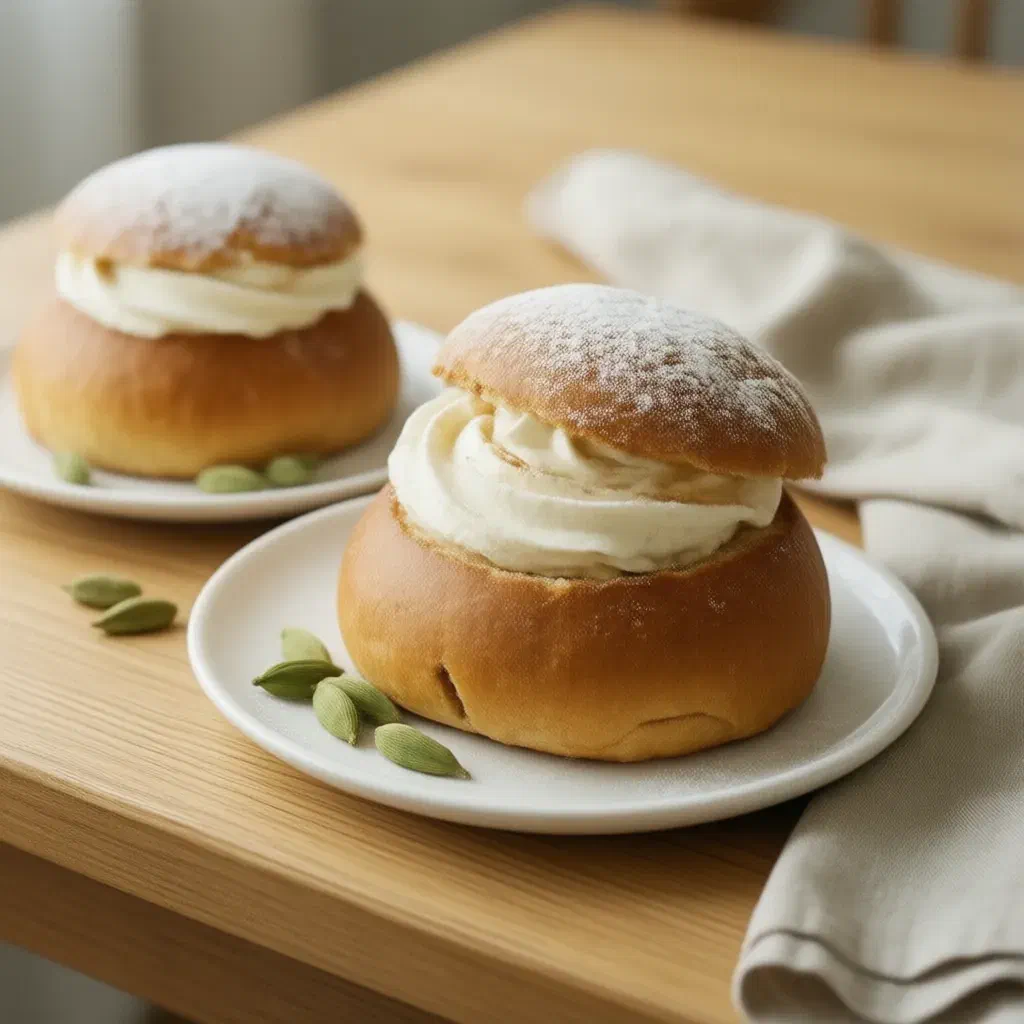
They are already on the shelves of many Swedish bakeries in December, and on Fettisdagen the Swedes eat an estimated six million of them. The semla is a small cardamom-scented yeast bun with its top sliced off. Underneath goes a filling of almond paste, and on top a thick ring of whipped cream. Baked at home, it tastes noticeably fresher than the supermarket version.
About Semla
Semla (plural semlor) is the Swedish Lenten pastry above all others. The dough is a soft, lightly sweet yeast dough seasoned with ground cardamom, much like the one you may know from Kanelbullar. After baking, a triangle or a round lid is cut from the top, the bun is hollowed out a little, and the crumb is mixed with almond paste and a splash of milk. This mixture goes back into the hollow, whipped cream is piped on top and the lid is put back in place. A dusting of icing sugar and it is done. The semla tastes of butter, almond and cardamom and is so soft that you eat it with a spoon. Traditionally it belongs to Fettisdagen, Shrove Tuesday, but today bakeries sell it from December until Easter.
Ingredients (serves 1–2)
- 150 g plain wheat flour (type 550)
- 10 g fresh yeast (or 3 g dried yeast)
- 80 ml milk
- 25 g soft butter
- 20 g sugar
- 1/2 tsp cardamom seeds, freshly crushed (or 1/2 tsp ground cardamom)
- 1 pinch of salt
- 1 small egg, beaten (half for the dough, the rest for brushing)
- 75 g raw marzipan or Swedish almond paste
- 2–3 tbsp milk for the filling
- 150 ml whipping cream (at least 30 % fat)
- 1 tsp sugar for the cream
- 1 tbsp icing sugar for dusting
Shopping for the ingredients
The cardamom is what makes the difference. Buy whole green pods from an Asian grocer or a spice shop, take out the black seeds and crush them fresh. Ready-ground cardamom loses its aroma within a few weeks. Swedish almond paste (mandelmassa) is roughly half almonds and half sugar. You can find it in Scandinavian shops or online. Raw marzipan from the baking aisle is the best substitute; ordinary modelling marzipan is too sweet. The cream should be well chilled, as it then whips up firm more quickly.
Preparing the dish
Warm the milk with the butter only until the butter melts and the mixture is lukewarm, about 37 °C. Milk that is too hot kills the yeast. Crush the cardamom and beat the egg. Set half of the egg aside for brushing. Line a baking tray with baking paper. The almond paste should be at room temperature, as it is hard to mix with the crumb when cold. If you are baking for a whole family, double or triple all the quantities and shape 8–12 buns on a large tray.
Step-by-step instructions
- Dissolve the yeast in the lukewarm milk and butter mixture and knead it with the flour, sugar, cardamom, salt and half of the egg for 8–10 minutes to a smooth, soft dough.
- Cover the dough and leave it to rise in a warm place for 45–60 minutes, until it has doubled in size.
- Divide the dough into 4 equal pieces of about 75 g each and shape them into smooth, round balls.
- Place the balls well apart on the tray, cover them and leave to rise for another 30 minutes. Preheat the oven to 200 °C (conventional, top and bottom heat).
- Brush the buns with the remaining egg and bake them on the middle shelf for 10–12 minutes until golden brown. Leave them to cool completely on a wire rack.
- Cut a lid about 1 cm high from the top of each bun and hollow out the bottom slightly with a teaspoon.
- Crumble the crumb you removed, stir it together with the grated almond paste and 2–3 tbsp milk to a spreadable paste, and fill the hollows with it.
- Whip the cream with 1 tsp sugar until stiff, pipe it in a thick ring onto the filling with a star nozzle, put the lids on and dust everything with icing sugar.
Gluten-free / lactose-free version
For a gluten-free semla you need a gluten-free flour blend for yeast doughs that contains psyllium husk or xanthan. Allow 10–15 ml more milk; the dough stays a little stickier and is easiest to shape with wet hands. Almond paste is naturally gluten-free, but check the label anyway. To make the buns lactose-free, use lactose-free milk, lactose-free butter and lactose-free whipping cream. All three are available in ordinary supermarkets and behave just like the originals when baking and whipping.
Tips for vegans and vegetarians
The semla is already vegetarian. For a vegan version, replace the milk with 80 ml oat or soya drink and the butter with 25 g plant-based margarine. Instead of egg in the dough, use 1 extra tbsp soya drink, and for brushing a mixture of 1 tbsp plant drink and 1 tsp maple syrup. For the topping, a whippable plant-based cream made from coconut or soya works well; 150 ml is enough. Raw marzipan is usually vegan already, but some brands contain honey.
More tips and tricks
The most common mistake is baking for too long. The buns should stay soft inside, and at this size they are done after 12 minutes. Fill them only shortly before serving, otherwise the cream soaks into the dough within two hours. Unfilled buns keep for a day in an airtight container and freeze well. Once thawed, they taste better if you warm them for 3 minutes at 160 °C and then let them cool. Filled semlor belong in the fridge and should be eaten the same day.
Adapting the recipe to your taste
If you like it less sweet, use half almond paste and half finely ground toasted almonds. Modern bakeries now fill them with pistachio paste, raspberries or chocolate. The old form is called hetvägg. Here the filled semla sits in a deep plate of hot milk, which you spoon up along with it. A distant relative is the German Berliner Pfannkuchen, which also belongs to carnival time but is deep-fried.
Ingredient substitutions
Without almond paste, a filling of 60 g ground almonds, 30 g icing sugar and 2 tbsp milk, briefly blitzed in a blender, works well. Cinnamon can stand in for cardamom at a pinch, but the buns will then taste more like cinnamon rolls. If you have no fresh yeast, use dried yeast and mix it straight into the flour. You can stabilise whipped cream with 1 tbsp mascarpone. Green-coloured marzipan, incidentally, is what covers the Prinsesstårta.
Drink pairing ideas
In Sweden, semla is almost always eaten with coffee, usually a strong filter coffee without sugar that stands up to the sweetness. A glass of cold milk goes just as well and is popular with children. If you do not like coffee, choose a black tea such as Assam or a rooibos with vanilla. An unsweetened apple and elderflower juice is a fresh alternative.
Serving and presentation ideas
Set each semla on its own small plate with a cake fork or a teaspoon beside it. The lid sits slightly tilted on the cream so the filling shows. Sift over the icing sugar right at the end, as it dissolves quickly on moist cream. For hetvägg, serve the semla in a deep bowl and pour hot milk over it at the table.
A bit of history
The semla goes back to a simple wheat bun eaten in Sweden before Lent. The name comes from the Latin simila, meaning fine wheat flour. For a long time the bun was eaten as hetvägg in warm milk. A well-known story has it that King Adolf Frederick died in 1771 after a lavish meal that ended with hetvägg. Whether the pastry was to blame has never been proven. Almond paste was added around the middle of the 19th century, and whipped cream towards the end of the century. The form we know today only became widespread from the 1930s. It is eaten above all on Fettisdagen, the Tuesday before Ash Wednesday. Finland has a similar pastry, the laskiaispulla, often filled with jam instead of almond paste.
More recipe ideas
Looking for more ideas? Discover more Swedish recipes.
Summary: Semla
A home-baked semla mainly needs time for the yeast dough; the filling is ready in ten minutes. Freshly crushed cardamom and an almond paste with a high almond content decide the flavour. Fill the buns only just before coffee time, and the bun stays light while the cream holds its shape.